10 Memory Techniques to Remember Everything You Study 🧠✨
Don't just read—remember! Discover 10 easy ways to boost your brain power, from the Feynman technique to the power of a good sleep
Introduction:
We have all been there: you spend hours reading a chapter, but the moment you close the book, you forget everything! 🤦♂️ The problem isn't your brain; it’s your method.
Science shows that our brains need a specific system to store information. If you want to stop "cramming" and start remembering, try these 10 easy memory techniques.
1. Spaced Repetition (The 24-Hour Rule) ⏳
Your brain is great at clearing out "garbage." If you study something today and don't look at it again for 24 hours, you will forget 80% of it.
The Trick: Review your notes after 1 day, then after 3 days, and then after 1 week. This moves information from your "short-term" to "long-term" memory.
2. The Feynman Technique (Teach it!) 👨🏫
Albert Einstein once said, "If you can't explain it simply, you don't understand it well enough."

(Alt Text: A student explaining a lesson to a friend using a whiteboard.)
How to do it: After studying a topic, imagine you are teaching it to a 10-year-old child. If you get stuck, go back and read that part again.
3. Use Mnemonics (Funny Phrases) 🎭
Can't remember a long list or a hard formula? Make it funny!
Example: To remember the colors of the rainbow (Red, Orange, Yellow, Green, Blue, Indigo, Violet), students use the name "ROY G. BIV." The funnier the phrase, the faster you remember it!
4. Visual Associations 🖼️
Our brains remember pictures much better than plain words.
Example: If you are learning about "Photosynthesis," don't just memorize the definition. Picture a green tree "eating" sunlight like a snack. 🍏
5. The Chunking Method 🧱
Break big pieces of information into smaller "chunks."
.The Trick: Just like we remember phone numbers in parts (0300- 1234567), break a long answer into 3 or 4 small bullet points. It makes the task feel much easier.
6. The Memory Palace 🏰
Imagine your house or your bedroom. "Place" a topic in every corner of the room. When you mentally walk through your room during an exam, you will "see" the answers waiting for you.
7. Active Recall (Close the Book!) 📖
Reading is not the same as learning. After reading one page, close the book and ask yourself: "What did I just read?" If you don't challenge your brain, it won't store the data.
8. Eat Brain Food 🍎
Your brain needs fuel to work properly!
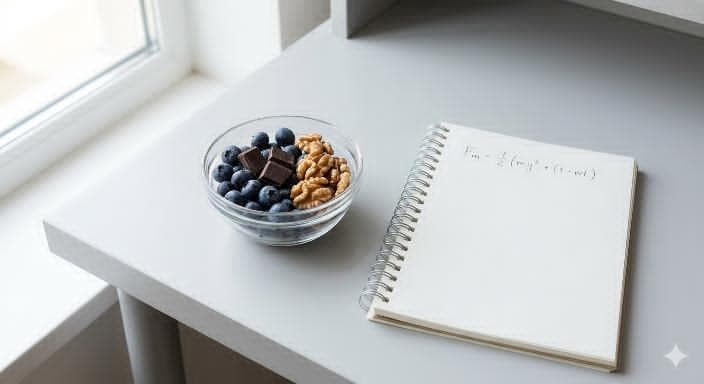
(Alt Text: Healthy snacks like walnuts and berries on a student's desk.)
Tip: Walnuts, dark chocolate, and fruits are great for memory. Avoid heavy "junk food" before studying as it makes you feel sleepy.
9. Never Skip Sleep 😴
Your brain "saves" what you learned during the day while you are asleep. Without 7-8 hours of sleep, your brain cannot store new information. No sleep = No memory.
10. The 5-Minute Rule ⏱️
When you really don't feel like studying, tell yourself: "I will only study for 5 minutes." Usually, the hardest part is starting. Once you start, your brain finds its rhythm.
The Science of Memory: Why it Works? 🧪
All these techniques use Neuroplasticity. Your brain is like a muscle. The more you use it actively (using Active Recall and Spaced Repetition), the stronger it gets.
Bonus Tip: Never study while you are stressed. A relaxed brain produces "Alpha waves," which are perfect for learning new things.
🎁 Download our Mnemonic Cheat Sheet to help you remember hard formulas instantly!
Read More: Active Recall Techniques | How to Stay Focused
Share this article: