5 Proven Note-Taking Methods to Improve Your Learning 📚
Stop struggling with messy notes! Learn how to use the Cornell, Mapping, and Charting methods to organize your thoughts and ace your exams.
Introduction
Taking notes is not just about writing down everything your teacher says. It is about organizing information so your brain can remember it later. If you want to save time during revision and get better grades, you need a system that works.
Here are 5 proven note-taking methods that every student should know. 🚀
1. The Cornell Method: The All-Rounder 📝
The Cornell method is one of the most popular techniques because it divides your page into three sections: Cues, Notes, and Summary.
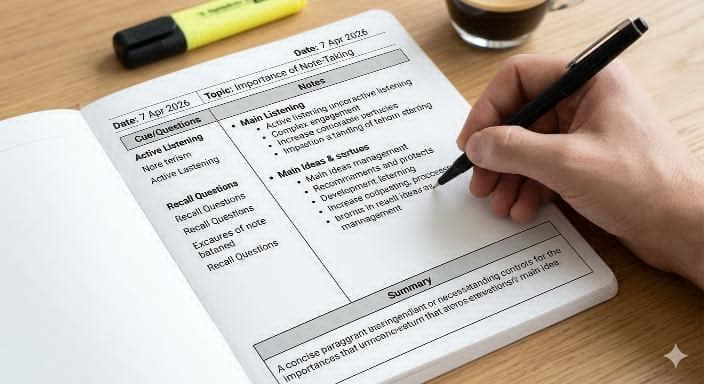
(Alt Text: Student using the Cornell note-taking method in a notebook.)
How it works: Divide your paper into two columns with a horizontal row at the bottom. Write main notes on the right, keywords or questions on the left, and a 3-sentence summary at the bottom.
Why it works: It forces you to review your notes immediately to write the summary, which helps in long-term retention. 🧠
2. The Mapping Method: For Visual Learners 🗺️
If you hate long paragraphs and love diagrams, this is for you. Mind mapping helps you see how different topics are connected.
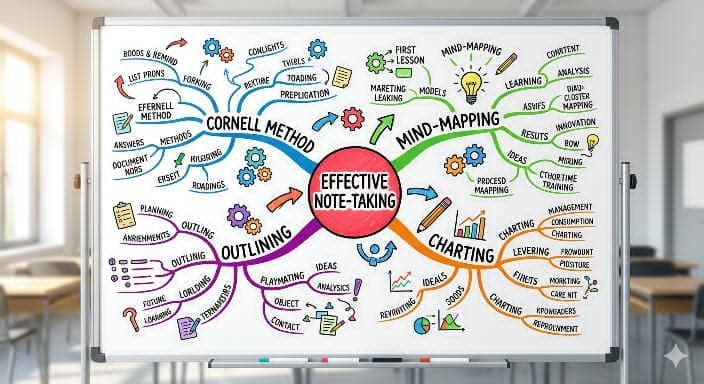
(Alt Text: Colorful mind map for creative brainstorming and study.)
How it works: Write the main topic in the center of the page. Draw branches for sub-topics and smaller twigs for supporting details.
Why it works: It’s perfect for subjects with complex relationships, like History or Biology. It makes your notes look like a "picture" of the lecture. 🎨
3. The Outlining Method: Simple and Organized 📋
This is the most natural way to take notes. It uses headings and bullet points to create a clear hierarchy.
How it works: Start with a main heading. Use a sub-heading for the next level of detail, and bullet points for specific facts.
Why it works: It keeps your notes very clean. When you go back to study, you can easily find exactly what you are looking for without reading a "wall of text." ⚖️
4. The Charting Method: For Data-Heavy Subjects 📊
When you are learning about dates, formulas, or comparing two things, the Charting method is a lifesaver.
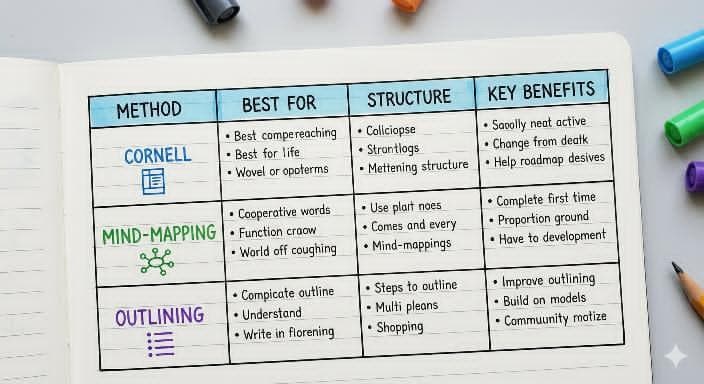
(Alt Text: Comparison chart of different note-taking techniques.)
How it works: Create a table with rows and columns. Label the columns with categories (e.g., "Date," "Event," "Impact").
Why it works: It cuts down the amount of writing you have to do and makes comparison very easy. It’s the best way to memorize facts quickly. 📉
5. The Annotation Method: For Active Reading 📖
This method is used directly inside your textbook or printed slides.
How it works: Use highlighters, underline key phrases, and write small notes or "questions" in the margins of the book.
Why it works: It keeps you engaged with the material. Instead of just reading passively, you are "talking" to the book. ✍️
How Good Notes Lead to Better Revision 💡
Why spend hours on these methods? Because Revision > Recording.
Reduces Stress: You won't feel lost before exams because your notes are already organized.
Saves Time: You only study the "meat" of the topic, not the fluff.
Active Recall: Methods like Cornell help you test yourself while you read.
Pro Tip: Always review your notes within 24 hours of taking them. This simple habit can improve your memory by up to 80%! 🌟
If you found this helpful, check out our other posts on Active Recall techniques and how to stay focused while studying.
Share this article: